
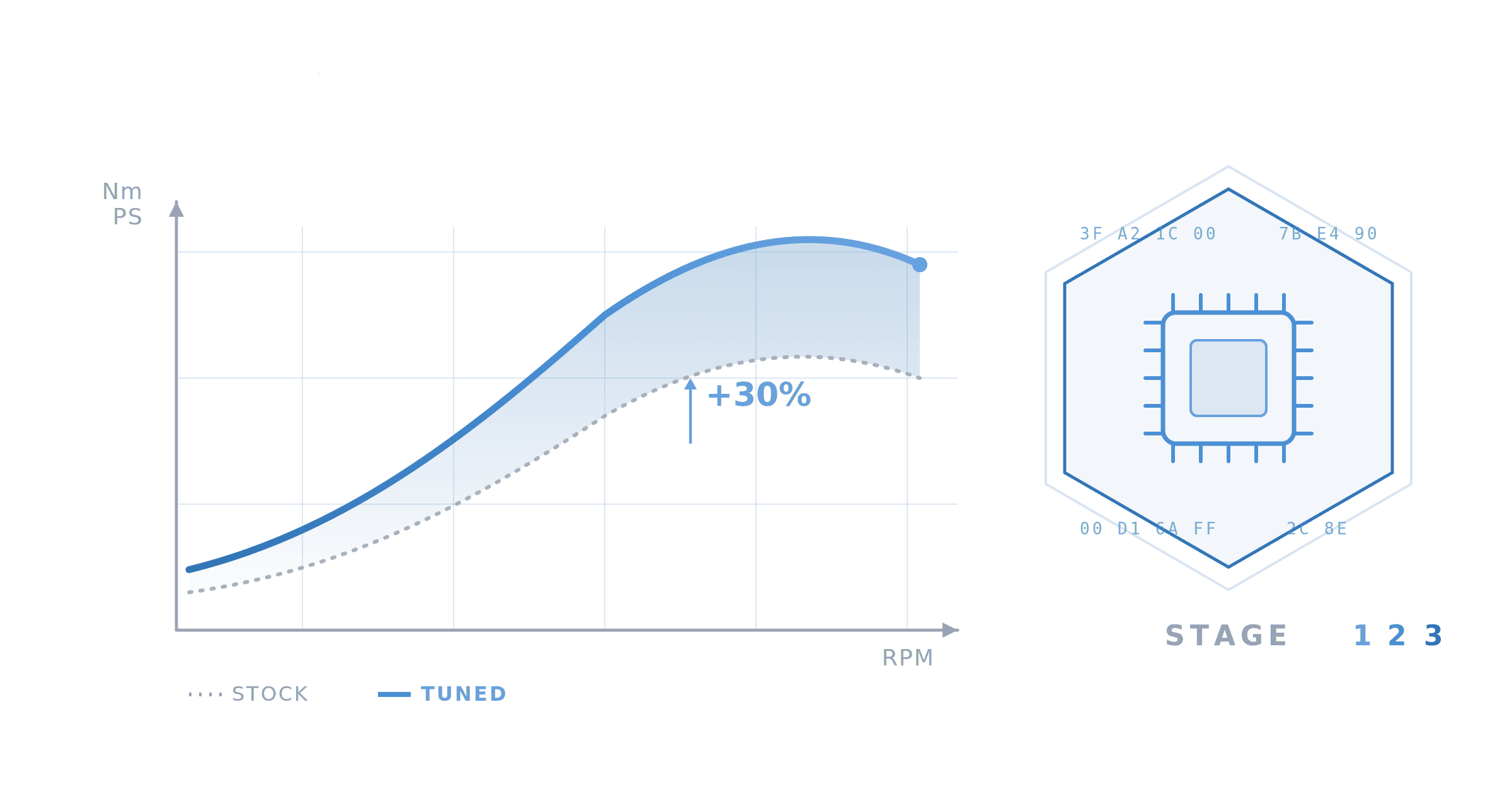
ChipTuning is one of those terms almost every driver has heard, yet few know what actually happens "under the hood" during the process. Some associate it with racing and burnt-out engines, others with a sensible way to unlock the performance a manufacturer deliberately left on the table. As usual, the truth sits somewhere in between.
This guide explains, without the marketing fluff, what chiptuning is, what it really changes in your car, how much power you can gain, when it makes sense and when it is a waste of money. We also cover the things workshops tend to stay quiet about - warranty, insurance and homologation.
What Is Chiptuning
Chiptuning is a modification of the engine control unit (ECU) software that changes how the engine operates. Most often the goal is to increase power and torque, but improving the engine's refinement or optimising fuel consumption can matter just as much.
In practice, no physical "chip" is swapped - the name is a leftover from older cars where a new memory chip really was soldered in. Today chiptuning simply means overwriting the maps that control the engine with new, modified software. That is why you will increasingly see the terms remap or ECU tuning - they all mean the same thing.
Every modern engine is computer-controlled. The ECU decides in real time on the fuel dose, ignition timing, boost pressure, injection timing and dozens of other parameters. All these values are stored as maps - tables the controller reads to know how to behave in a given situation. Chiptuning is nothing more than an intelligent change to those tables.
How Chiptuning Works - Step by Step
The whole operation, though it sounds like black magic, follows a repeatable and logical sequence.
1. Reading the Original File
The engineer reads the original software from the controller - either through the OBD diagnostic port or, when the manufacturer has locked access, via the BENCH or BOOT method, meaning directly from the opened unit. This original file is both the starting point and a backup you can always return to.
2. Modifying the Maps
This is the heart of the process. The engineer analyses the fuel, boost, torque, pressure and temperature limit maps, then adjusts them to extract more output without going beyond safe margins. This is where knowledge of the specific powertrain and real experience count - which is why the files at Hextuni are made by real engineers, not an automated tool spitting out a generic file from a database.
3. Writing the Modified File
Once the new version is ready, the software is written back to the controller through the same channel it was read from. From that moment the engine runs on the new maps.
4. Testing and Verification
Proper tuning ends with a test - on a dyno, which shows the real power and torque figures, or at least a test drive with live parameter logging. This is the step that separates a reputable workshop from a "file flasher".
What Chiptuning Really Changes in Your Car
Time to get realistic, because plenty of myths surround chiptuning.
- Power and torque - the most visible effect. Depending on the unit, power gains can range from around ten to even thirty percent, and in diesels torque often climbs even more. It is that torque increase you feel most in daily driving - the car pulls more eagerly and overtakes with confidence.
- Refinement - a well-prepared file can smooth out the engine's character, remove the low-rev "flat spot" and make the unit respond to the throttle more linearly.
- Fuel consumption - an area full of misunderstanding. Chiptuning is not a magic fuel-saving trick, but with the same driving style you really can lower consumption, since more torque low down lets you drive "in a higher gear" at lower revs. Start using the extra power, though, and consumption goes up. Simple physics.
Stage 1, Stage 2, Stage 3 - What the Levels Mean
Listings and offers constantly mention "stages". It is a loose scale of how far the modification goes:
- Stage 1 - tuning at the software level only, with no mechanical changes. The car stays stock, only the software changes. This is the most popular and safest option for the everyday driver.
- Stage 2 - software matched to mechanical modifications already fitted, such as a sports intake, a more efficient intercooler or a downpipe. It already requires spending on parts and targets more knowledgeable users.
- Stage 3 - a deep rebuild, often with a larger turbo, injectors and modified hardware. This is the domain of dedicated performance cars and project builds, not a daily driver.
For the vast majority of drivers, the sensible and entirely sufficient choice is Stage 1.
Chiptuning Turbocharged vs Naturally Aspirated Engines
Here lies the answer to why some people are thrilled with the results and others are disappointed.
Chiptuning works best on turbocharged engines, where the factory maps often leave plenty of headroom. For various reasons - emissions, model segmentation, safety margins for different markets and fuels - the manufacturer sets the turbo conservatively. By safely raising boost pressure and matching the fuel dose, you can unlock power that is physically already there.
On naturally aspirated engines the effect is far smaller, because there is no boost to play with. Real gains are usually a few percent and relate more to character than raw numbers. That does not mean tuning an NA engine is pointless - but you need realistic expectations.
Chiptuning Diesel vs Petrol
- Diesel - the chiptuning classic. Modern turbodiesels respond to a remap exceptionally well: a big torque increase, better flexibility and often lower consumption with relaxed driving. That is why diesels are among the most commonly tuned cars.
- Petrol - turbocharged petrol engines (TSI, TFSI, EcoBoost and similar) also respond brilliantly to tuning. On naturally aspirated petrol units, as noted above, the effects are more modest.
When Chiptuning Makes Sense - and When It Doesn't
Let's turn this into concrete guidance.
Chiptuning makes sense when:
- you have a modern turbocharged engine (diesel or petrol) in good mechanical condition,
- you care about more flexibility and driving comfort, not just numbers on paper,
- you go to a reputable specialist who prepares the file individually and tests the result,
- you treat it as a sensible modification, not a way to turn a city car into a race car.
Chiptuning does not make sense (or is risky) when:
- the engine is worn, tired or has unresolved faults - tuning will only expose and accelerate them,
- you have a weak naturally aspirated engine and expect a revolution,
- you are tempted by the cheapest "flash a file from the database" offers with no verification,
- you are not ready to accept the formal consequences (more on those below).
The golden rule: always consult the scope of the modification with a specialist who knows the specific unit. They will tell you how much can be safely extracted from your particular engine.
The Most Common Chiptuning Myths
- "Chiptuning destroys the engine" - a badly done one, yes. A properly prepared file stays within the components' strength margins. Trouble starts where someone pushes the parameters to the limit without knowledge and testing.
- "After tuning a car always burns more fuel" - only if you use the extra power. With the same driving style, consumption can even drop.
- "Tuning is just flashing a file off the internet" - that is the worst and cheapest route. Reputable chiptuning means individual adjustment to the specific car.
- "It can't be detected" - manufacturers and authorised service centres can detect software modifications. Worth remembering in the context of warranty.
Chiptuning, Warranty, Insurance and Regulations
This is the section worth reading before you visit a workshop. Rules differ between countries, so treat the points below as general principles and confirm the specifics for your jurisdiction.
- Warranty - chiptuning a car under factory warranty carries the risk of losing it for the powertrain. The manufacturer may refuse a claim if it detects software tampering.
- Insurance - changing engine parameters is a significant vehicle modification. In the event of a claim, the insurer may examine whether the car matched the details declared in the policy. For your own protection it is wise to inform your insurer about the modification.
- Homologation and inspection - increasing power is formally a change to the vehicle's technical data. Regulations in this area are interpreted differently and change over time, so the current legal status is best confirmed directly with a testing station or an appraiser.
In short: chiptuning is popular and widely performed, but it carries formal consequences you are better off knowing in advance rather than discovering after the fact.
How Much Does Chiptuning Cost
The price depends on the powertrain, the scope of the modification (Stage 1, 2 or 3) and the method of reading the controller. The simplest software-only Stage 1 for a popular diesel is relatively affordable, and the cost rises with complexity and the amount of engineering work required.
Beware of extremes. A very low price is usually a sign you are getting a generic file from a database with no verification - a saving that can cost dearly when the engine needs repair. On the other hand, a high price alone is no guarantee of quality. What matters is who prepares the file and how.
How to Choose a Good Specialist
A few things worth checking:
- An individual approach - is the file tailored to your car, or just pulled from a database?
- Verified results - does the workshop offer dyno measurement or at least testing from logs?
- Experience with the specific unit - does the specialist know your particular engine and its limits?
- A backup - is the original file kept, so you can return to factory condition if needed?
At Hextuni, files are prepared by engineers with real experience on specific powertrains, not by an automated tool generating universal "ready-made" files. We treat every order individually - because that is the only way chiptuning makes sense.
FAQ - Frequently Asked Questions
Is chiptuning safe for the engine? Done properly and kept within the components' strength margins - yes. The risk appears when parameters are pushed too far or when a worn engine is tuned.
How much power does chiptuning really add? On turbo engines usually from around ten to thirty percent, and in diesels often with a large torque gain. On naturally aspirated engines the effects are far more modest.
Does chiptuning increase fuel consumption? Only if you use the extra power. With relaxed driving, the added low-end torque can even lower consumption.
Can chiptuning be reversed? Yes, as long as the original file was saved. You can then restore the factory controller software.
Does chiptuning void the warranty? It can cause the loss of warranty for the powertrain if the manufacturer detects the software modification.
Which Stage should I choose for daily driving? For the vast majority of drivers, Stage 1 is optimal - software-only tuning with no mechanical changes.
Want to know how much can really be unlocked from your car? Get in touch through Hextuni - we will prepare an individual quote and advise a safe scope of modification for your powertrain.